Physicians’ Perspectives: Academy Advocates on Capitol Hill
Physicians who attended the AAO-HNS Congressional Advocacy Day came with a shared conviction that showing up matters.
AAO-HNS
For the first time since the pandemic, the Academy brought physician members from around the country to Washington, DC, to meet with their lawmakers and congressional staff, advocating for policies that support both patient care and physician practices. With 40 attendees participating in more than 70 meetings, the day marked a powerful return for physician-led advocacy on Capitol Hill.
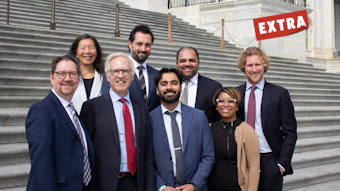
Left to right: Bobby Mukkamala, MD, Dole P. Baker, Jr., MD, Katherine Kavanagh, MD, Matthew D. Scarlett, MD, and Gene Brown, MD, RPh,outside the Russell House Office Building on Capitol Hill.Academy members discussed key priorities, including federal legislation to protect Medicare patients' access to care, expand coverage for medically necessary hearing devices, and improve early detection of congenital CMV. Participants were also joined by AAO-HNS President Gene Brown, MD, RPh, and American Medical Association President and fellow otolaryngologist Bobby Mukkamala, MD, a testament to the specialty's strong and unified voice in national health policy.
Why They Showed Up
The physicians who attended Hill Day came from different states, with diverse backgrounds and years of experience, but they shared a conviction that showing up matters. Academy staff asked participants to finish the sentence: "I'm here because my patients deserve …" Their answers were a powerful reminder that advocacy is an extension of patient care.
That spirit was evident in the passion each member brought to Capitol Hill. As Angela Powell, MD, of Plattsburgh ENT in New York, put it:
"I am passionate about legislative advocacy and encourage every one of my colleagues to get involved with the Academy's efforts to keep our practices sustainable and to reduce the administrative burden that leads to reduced access to care in our communities. This is OUR fight, please join me in it!"
Front row, left to right: Daniel R. Gold, MD, Stephen P. Cragle, MD, Uzair Kahn, Angela Powell, MD. Back row, left to right: Cynthia Go, MD, Shawn Stevens, MD, Ameya Jategaonkar, MD, Austin Swisher, MD.A veteran of multiple Hill Days over the years, Dr. Powell knows firsthand why showing up is what makes the difference:
"As a constituent, communicating directly with my legislator or their aide is essential. When bills negatively affect my practice and patients in our community, making that impact clear helps secure co-sponsorship and move legislation forward for a vote. Building these relationships ensures that our voices as the subject matter experts on healthcare are heard and that our presence makes a difference.”
Building Relationships That Drive Change
That sense of obligation, to act rather than observe, resonated across the group. Matthew D. Scarlett, MD, of Charleston ENT and Allergy and Chair of the ENT PAC Board of Advisors, summed up the mindset that brought him to DC:
"Our healthcare system has real problems, but complaining doesn't fix them. That's why I joined this year's Hill Day, bringing my perspective as a practicing physician directly to congressional offices to fight for our specialty and the physicians we represent."
First row, Left to Right: Karen Rizzo, MD, Evelyne Kalyoussef, MD, Eileen M. Raynor, MD, Mamie Higgins, MD, Emily Youner, MD. Back row, Left to Right: Amelia Drake, MD, Robin Lindsay, MD, Yolanda Troublefield, MD, JD, Adithya Srikanthan, MD, Barbara Goheen Brodish, MD, Matthew Smith, MD, MPH.
Eileen M. Raynor, MD, with Duke University Department of Head and Neck Surgery & Communication Sciences and Board of Governors (BOG) Chair-Elect, brought an even broader perspective to why that engagement is so essential—and why it must happen at every level of government:
"Advocacy is critical to preserve the sanctity of the physician-patient relationship and avoid third parties, including government, from intruding on this unique experience. Physicians have to stand up for their patients and their ability to care for them. Otherwise, others will make decisions that are not patient-centric and are mostly financially motivated.
“We have to be engaged, make connections with our state and federal legislators, and be a resource for them when healthcare-related questions arise. Together we are stronger, and our collective voice can make a huge difference for our patients and our specialty."
Advocacy as an Extension of Care
Left to Right: Evelyne Kalyoussef, MD, Karen Rizzo, MD, Eileen Raynor, MD, Yolanda Troublefield, MD, JD.For Yolanda Troublefield, MD, JD, of Southcoast ENT and Vice Chair of the BOG Socioeconomic and Grassroots Committee, the connection between advocacy and patient care is both deeply personal and deeply practical. Her path into advocacy was shaped by a mentor whose influence continues to ripple outward:
“I participate in advocacy activities, such as Hill Day, because my patients deserve quality healthcare, and advocacy is vital to achieving that goal. Dr. Eisenberg inspired my interest in advocacy by highlighting its importance to ensure that our voices are heard in Washington, DC. Engaging with lawmakers helps to secure programs and funding essential to our daily work and benefits each and every one of our patients.
“I encourage all members to get involved, and the easiest place to start is to contact the Advocacy staff or anyone on the Board of Governors. The BOG can help members become seamlessly acclimated to the world of advocacy and make it easy to incorporate into their everyday practice. Believe it or not, it is not as hard as you think, and it is an effective way to impact the legislative process personally."
Left to Right: Emily Youner, MD, Lee D. Eisenberg, MD, MPH, Austin Swisher, MD.That mentor, Lee D. Eisenberg, MD, MPH, who is a longtime leader in advocacy for the specialty and the Academy and is the namesake for the AAO-HNS Lee Eisenberg Resident in Advocacy Scholars Program, has been attending advocacy events like this for over 25 years, and this year carried extra meaning for him:
"Attending the legislative Hill visits and advocating for otolaryngology-head and neck surgery is one of the most important things we can do. It is a unique experience to present and discuss issues of concern to our specialty with Hill staff. We often educate them in areas in which they have little to no knowledge. It may lead to a longer-term relationship where you can be the point of contact for any medical-related issue.
“This year was very exciting for me as the first two recipients of the Eisenberg Resident in Advocacy Scholars Program attended. As you read from their comments, it was an eye-opening experience and the beginning of a lifelong commitment to advocacy."
A New Generation Finds Its Voice
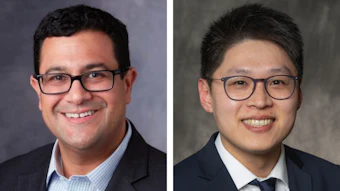
Austin Swisher, MD, and Emily Youner, MD, on the steps of the Capitol for the 2026 Congressional Advocacy Day.The first two resident recipients for 2026 are Austin Swisher, MD, PGY-2 at the Mayo Clinic Otolaryngology-Head and Neck Surgery Residency Program in Arizona, and Emily Youner, MD, PGY3 at University Hospitals Otolaryngology-Head and Neck Surgery Residency Program. They both brought a perspective that proved uniquely valuable on the Hill. Dr. Swisher arrived with some uncertainty and left with a new sense of purpose:
"I arrived on Capitol Hill expecting formality and left surprised by its accessibility. Staffers genuinely respected input from the physician perspective. Leading discussions on our core issues across multiple offices, I grew more confident with each meeting, finding my footing and learning what it truly means to advocate. What struck me most was witnessing democracy at its roots: constituents and advocates showing up, making their case, and driving change.
“As an ENT resident, we occupy a unique position as we are close enough to patients to speak authentically, but early enough in our careers that the policies we fight for will define the field we ultimately inherit. Engaging at the highest levels of policy makes me feel like I'm contributing to something bigger than myself and bigger than any single patient encounter.
“Connecting with legislators matters because change begins with familiarity and trust, and the only way to build that is through continued, in-person engagement."
Fellow grant recipient Dr. Youner came in with her own reservations and found them quickly dispelled:
"Advocacy Day far surpassed my expectations. Initially, I was anxious that I wouldn't have much to contribute, given that I felt I lacked experience. However, it soon became clear to me that, even as residents, we are the experts on the issues affecting our patients and have the credibility to speak up on their behalf. It was great to meet ENT surgeons from around the country and learn from their experiences. Attending Hill Day demonstrated that we have the expertise and wherewithal to advocate for our patients, and I had a lot of fun doing it."
The conversations happening in congressional offices weren't just feel-good moments; they produced tangible results. Stephen P. Cragle, MD, of St. Cloud Ear, Nose & Throat in Minnesota and BOG Chair, witnessed the impact directly:
Stephen P. Cragle, MD, at the offices of U.S. Representative Tom Emmers, who represents the 6th district in Minnesota."Along with 40 of my colleagues, I heard policy experts discuss a number of hot-button issues that impact our patients and our practices. Some affect all of us in the house of medicine, and some are particular to otolaryngology. Armed with handouts and an app, we spread out on Capitol Hill for appointments with our senators and congressperson. We discussed children's hearing health issues and Medicare payment reform, and the staffers I spoke with responded to our visits positively. Senator Amy Klobuchar's office later messaged to say they are signing on as a co-sponsor of one of the bills we advocated for.
“One takeaway from the event is that our federal legislators respect and listen to physicians and really want to hear our stories about how our patients and staff are affected by federal policies. They hear regularly from lobbyists who represent lawyers, hospitals, and industry, but rarely from practicing physicians. When they do, they really seem to listen. I feel that I was able to establish some good relationships, and I look forward to further opportunities to advocate for my patients and for our specialty."
From Bystander to Advocate
Not every attendee arrived as a seasoned advocate. For Christine Franzese, MD, who is with the Department of Otolaryngology at the University of Missouri Medical Center, the event represented a turning point for her, recognizing that silence has its own consequences:
"I realized that I've taken for granted all the hard work that has been done in the past by the Academy. However, I see how healthcare access worsens in our area: Prior authorizations become more prolific and more challenging, and the administrative paperwork becomes more burdensome for our practice, while our support staff has been cut. I realized that I needed to become more active in helping my colleagues, my specialty, my patients, and myself."
Left to Right Jacob Manthey, MBA, MsHCM, Christine Franzese, MD, Lance A. Manning, MD, Yolanda Troublefield, MD, JD, Adithya Srikanthan, MD, Samuel Hutton.
“I realized that staying silent, not participating, not making my voice heard was part of the problem, and I wanted to become part of the solution. I also realized that I am at a point in my career where I can afford to take some time away to advocate for my specialty and my colleagues, whereas others may not be able to do so.
“Having never been to Capitol Hill, I was not sure what to expect, but was incredibly surprised and pleased with how effective these meetings were with my representatives. I found that meeting with my Missouri congressional and senate representatives was productive, and I made connections I didn't expect to make. I will definitely do this again, and I feel by doing so that I can really make a difference advocating for my fellow otolaryngologists."
2026 Congressional Advocacy Day participants during the training session held the day before the 70+ meetings on Capitol Hill. Get Involved
The stories from this year's Hill Day share a common thread: showing up works. Physicians who came unsure left energized, and conversations that started in a single office are already translating into legislative action.
Although Congressional Advocacy Day is just one day a year, the Academy's advocacy efforts are year-round. Join theENT Advocacy Networkto stay up to date on state and federal legislative actions, as well as health policy, regulatory, and payer issues. Your voice and your presence matter more than you might think.
*Contributions to ENT PAC are not deductible as charitable contributions for federal income tax purposes. Contributions are voluntary, and all members of the American Academy of Otolaryngology–Head and Neck Surgery have the right to refuse to contribute without reprisal. Federal law prohibits ENT PAC from accepting contributions from foreign nationals. By law, if your contributions are made using a personal check or credit card, ENT PAC may use your contribution only to support candidates in federal elections. All corporate contributions to ENT PAC will be used for educational and administrative fees of ENT PAC, and other activities permissible under federal law. Federal law requires ENT PAC to use its best efforts to collect and report the name, mailing address, occupation, and the name of the employer of individuals whose contributions exceed $200 in a calendar year.
 Left to right: Bobby Mukkamala, MD, Dole P. Baker, Jr., MD, Katherine Kavanagh, MD, Matthew D. Scarlett, MD, and Gene Brown, MD, RPh, outside the Russell House Office Building on Capitol Hill.
 Front row, left to right: Daniel R. Gold, MD, Stephen P. Cragle, MD, Uzair Kahn, Angela Powell, MD. Back row, left to right: Cynthia Go, MD, Shawn Stevens, MD, Ameya Jategaonkar, MD, Austin Swisher, MD.
 First row, Left to Right: Karen Rizzo, MD, Evelyne Kalyoussef, MD, Eileen M. Raynor, MD, Mamie Higgins, MD, Emily Youner, MD. Back row, Left to Right: Amelia Drake, MD, Robin Lindsay, MD, Yolanda Troublefield, MD, JD, Adithya Srikanthan, MD, Barbara Goheen Brodish, MD, Matthew Smith, MD, MPH.
 Left to Right: Evelyne Kalyoussef, MD, Karen Rizzo, MD, Eileen Raynor, MD, Yolanda Troublefield, MD, JD.
 Left to Right: Emily Youner, MD, Lee D. Eisenberg, MD, MPH, Austin Swisher, MD.
 Austin Swisher, MD, and Emily Youner, MD, on the steps of the Capitol for the 2026 Congressional Advocacy Day.
 Stephen P. Cragle, MD, at the offices of U.S. Representative Tom Emmers, who represents the 6th district in Minnesota.
 Left to Right Jacob Manthey, MBA, MsHCM, Christine Franzese, MD, Lance A. Manning, MD, Yolanda Troublefield, MD, JD, Adithya Srikanthan, MD, Samuel Hutton.
 2026 Congressional Advocacy Day participants during the training session held the day before the 70+ meetings on Capitol Hill.
  2026 Congressional Advocacy Day participants during the training session held the day before the 70+ meetings on Capitol Hill.