The ‘Hybrid’ Clinical Workspace: Physicians, Employees, and AI Agents
"Hybrid" no longer means remote versus in-office—it means humans and AI working together to reduce burden and enhance patient care.
(See author’s disclosures at the end of this column.)
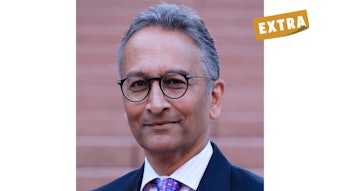
 Rahul K. Shah, MD, MBA
AAO-HNS/F Executive Vice President and CEO
In this hybrid workplace, physicians remain at the core of care delivery, but they're supported by a genuinely hybrid workforce: human employees (APPs, RNs, front/back-office staff) working alongside agentic AI. This isn’t artificial intelligence replacing human judgment, but augmented intelligence that eliminates administrative burden and amplifies clinical excellence. This isn't theoretical; it's already happening in your practices.

Consider the ambient scribe. A few years ago, medical scribes were human employees: valuable team members who documented patient encounters, allowing physicians to maintain eye contact and focus on clinical care. Today, ambient AI scribes perform this same function through speech recognition and natural language processing. This is the hybrid clinical workspace.
Think about your current practice infrastructure. You likely already have:
- Electronic medical records with AI-driven clinical decision support
- Scheduling systems with intelligent optimization algorithms
- Billing software with AI-assisted coding recommendations
- Patient communication platforms with automated appointment reminders and follow-up
- AI-powered dictation software that learns your voice patterns and specialty-specific terminology
Each of these represents an AI agent performing work that previously required human effort. The hybrid workforce is already here. Now we must think systematically about how to leverage it.
Agentic AI differs from traditional software in its autonomy and adaptability. Traditional software follows rigid rules: If X happens, do Y. Agentic AI interprets context, learns from patterns, adapts to new situations, and executes complex multistep tasks with minimal human oversight.
I use AI as a collaborative tool in writing these Bulletin columns. It doesn't replace my thinking or voice; rather, it augments my ability to communicate efficiently and effectively. I use AI as a thought partner [Claude is my large-language model (LLM) of choice]. My current workflows have several types of AI agents assisting me.
The same should apply to your practices.
An ambient scribe doesn't replace your clinical judgment about what's medically relevant; it removes the administrative burden of documentation. An AI scheduling agent doesn't decide which patients need urgent appointments; it optimizes your schedule to maximize patient access while minimizing gaps and inefficiencies.
The physician remains the captain of the ship, the leader of team-based care, and the clinical decision-maker. However, the composition of that team now includes both human colleagues and AI agents, each contributing their unique capabilities. This is the “hybrid clinical workspace.”
This evolution has profound implications for how we think about practice management, hiring, and workforce development.
When evaluating whether to hire another medical assistant, front desk coordinator, or scribe, forward-thinking practices now ask, "Should this be a human employee, an AI agent, or a hybrid role where a human employee works in concert with AI tools?" The answer depends on the specific tasks, the required human judgment, and the nature of patient interaction.
Human employees excel at complex problem-solving, empathetic patient interaction, nuanced clinical judgment, and tasks requiring deep contextual understanding. AI agents excel at pattern recognition, data processing, repetitive documentation, scheduling optimization, and executing well-defined workflows at scale.
The most efficient practices won't be those that simply adopt AI or those that resist it; they will be those that thoughtfully integrate AI agents with human employees, allowing each to operate at the top of their capability.
As I discussed in my Day One column, we're in a continuous process of modernization here at Academy headquarters. The Academy itself is deploying our DANI AI assistant to help members more efficiently access and use all available resources. We're not implementing AI because it's trendy; we're implementing it because it demonstrably reduces burden and improves service delivery.
Your practices deserve the same strategic approach.
The Academy is committed to helping you navigate this transition. At the upcoming AAO-HNS/F 2026 OTO Forum, to be held March 20-21 in Louisville, Kentucky, there will be content on AI implementation, practice efficiency, and emerging technologies. These aren't abstract discussions about future possibilities; they're practical sessions on tools you can implement immediately.
This transition will accelerate over the coming years. The practices that thrive will be those that embrace this evolution thoughtfully, maintaining the irreplaceable human elements of medicine while leveraging AI. The physician will always remain at the core. Your clinical judgment, your empathy, your patient relationships, your expertise—these are irreplaceable. But the team around you is evolving. In 2026, when you think about your hybrid workplace, think beyond remote versus in-office. Think about a workforce where human employees and AI agents each contribute their unique strengths in the service of excellent patient care.
The question isn't whether to adopt this model. The question is how strategically you'll design your hybrid workforce to maximize value for your patients, your employees, and yourself.
Welcome to the new hybrid clinical workspace. Let’s go!
Disclosure: Dr. Shah is an investor in ScribeBrain, an ambient scribe company.