How Are Your New Year's Resolutions Looking?
The difference between a failed resolution and a successful goal often comes down to intentionality, accountability, and a community committed to helping you succeed.
 Gene G. Brown, MD, RPh
AAO-HNS/F President
For eternal optimists like me, this is always going to be the year—the year I finally achieve sustainable weight loss, commit to consistent exercise, and lower my golf handicap. By this point in February, I'm usually recalibrating these goals to something more achievable.
While personal resolutions may falter, professional goal-setting demands greater discipline. At Charleston ENT & Allergy, we begin every year with a practice retreat focused on clinical excellence and strategic business planning. Maybe you do something similar? Unlike my personal resolutions, these goals are intentional, measurable, and reviewed monthly. There's something about collective accountability that makes the difference between aspiration and achievement.
At your Academy, we've started 2026 with similar intentionality—and considerable momentum. Rather than simply listing initiatives, we began by asking fundamental questions: What unique value does the AAO-HNS bring to our specialty, and where can we make an impact that no other organization can? What gaps are we uniquely positioned to fill? What can we do organizationally to maximize impact for our members and their professional careers? And, most importantly, how can we position the next generation of otolaryngologists for maximum success and career satisfaction? On the patient side, how can we bring better treatments to their communities to improve quality of life?
The answers to these questions have crystallized our focus for the year ahead.
Advocacy remains our cornerstone. If you missed the deadline for the "First 50 Campaign," you haven't missed your opportunity to strengthen our political voice—we accept contributions to the ENT PAC* year-round. As healthcare policy in the United States grows increasingly complex and consequential, building our ENT PAC funding isn't just important: It's essential. Every dollar invested increases our ability to advocate for our patients and our specialty in Washington, DC.
I'm particularly excited about expanding the Academy's role in the business of medicine education. We have a generation of brilliantly trained physicians who can masterfully navigate complex surgical anatomy but find themselves unprepared for the equally complex landscape of practice management, coding regulations, and healthcare economics. This knowledge gap doesn't just affect individual careers—it threatens the sustainability of independent practice itself.
No matter where you practice, you're not immune to the business pressures reshaping medicine. Across all practice settings, otolaryngology faces the same reality: physicians can no longer focus solely on patient care. The business of medicine infiltrates every model. We must confront this challenge directly to advocate effectively for our practices, our patients, and our specialty. Strengthening our business education offerings accomplishes two critical goals: we better equip early-career physicians for the realities of modern practice, and we demonstrate a tangible membership value. In an increasingly fragmented specialty landscape where multiple organizations compete for membership dollars, showing concrete value isn't optional—it's survival. The commitment to the membership was cemented this year when Christina Baldassari, MD, was selected by the search committee and approved by the Boards of Directors as our inaugural Coordinator of Membership Engagement.
Perhaps most significantly, 2026 will see an increased focus on specialty unity. With more than 12,000 otolaryngologists practicing in the U.S., we're simply too small to afford division. Yet our specialty has become increasingly fragmented by subspecialty focus, practice setting, and organization allegiance.
One Otolaryngology-Head & Neck Surgery builds on the success of our Specialty Unity Summit by creating ongoing stakeholder oversight across all otolaryngology subspecialties. This initiative brings together leaders from the entire specialty of otolaryngology to coordinate workforce planning, advocacy efforts, and other specialty-centric challenges that may arise over time. The goal is simple but profound: ensure that when we speak, we speak with one voice. When we plan, we plan together. When we advocate, we advocate as a unified specialty. As this initiative takes shape, we'll provide more details about its purpose and goals.
Maximum alignment isn't just an admirable aspiration—it's a strategic imperative for a specialty of our size.
So, while my personal New Year's resolutions may need some midcourse corrections (I'm not giving up on that golf handicap just yet), I'm confident in the goals we've set for your Academy. They're specific, strategic, and backed by the collective commitment of leaders who understand what's at stake.
Whatever resolutions you made for 2026—personal or professional—I wish you success in your pursuit. And if you need to recalibrate along the way, remember: the difference between a failed resolution and a successful goal often comes down to intentionality, accountability, and a community committed to helping you succeed.
That's exactly what we're building together at the AAO-HNS/F. I hope that you, your families, your practices, and departments all have a great year—I'm sure you're well on your way!
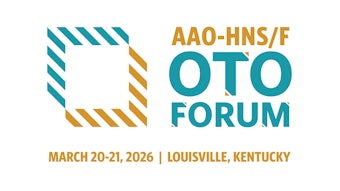
Join us at the AAO-HNS/F 2026 OTO Forum in Louisville, Kentucky, this March for in-depth conversations on the business of medicine and clinical excellence—open to all otolaryngologists from residents to established practitioners across every practice setting. Learn more and register today!
*Contributions to ENT PAC are not deductible as charitable contributions for federal income tax purposes. Contributions are voluntary, and all members of the American Academy of Otolaryngology-Head and Neck Surgery have the right to refuse to contribute without reprisal. Federal law prohibits ENT PAC from accepting contributions from foreign nationals. By law, if your contributions are made using a personal check or credit card, ENT PAC may use your contribution only to support candidates in federal elections. All corporate contributions to ENT PAC will be used for educational and administrative fees of ENT PAC and other activities permissible under federal law. Federal law requires ENT PAC to use its best efforts to collect and report the name, mailing address, occupation, and the name of the employer of individuals whose contributions exceed $200 in a calendar year.